
Finding Hazlet Residents Through Records
Hazlet has no single public roll that lists every household. The useful path changes with the fact already known. A current street address works best in the Monmouth tax system, where a Hazlet parcel can be tied to a block and lot. A name can be checked against the New Jersey voter tool, a recorded land document, or a public court index, depending on the question. Older Hazlet residents need a different route: county archives, the library, the Monmouth County Historical Association, and state archival material preserve names long after a current portal stops.
Each record answers a narrow question. A tax entry can identify an assessed owner and property location. A deed may show parties and the date of a transfer. A voter result addresses registration, not physical presence. Historical directories and obituaries are dated snapshots. Keep the source date beside each result, and compare independent records before treating a match as the right Hazlet person.
- Start with the county property roll when a Hazlet address, street, or block and lot is known.
- Use the statewide voter search to confirm a registration record with the exact name, date of birth, county, and municipality.
- Search the County Clerk land index for a deed, mortgage, lien, or other recorded transaction tied to the parcel or party.
- For an older household, ask the library or MCHA to check directories, obituaries, censuses, or cemetery material.
- When a record is not online, ask the named custodian for an existing record through the counter, telephone, mail, or a focused OPRA request.
Note: A missing portal result can reflect a date cutoff, a spelling difference, redaction, or a different records custodian.
Hazlet Residents Record Custodians
Hazlet Township creates municipal records, while Monmouth County and New Jersey keep many of the searchable indexes. The township clerk maintains minutes, books, deeds, contracts, and archival material. The assessor connects a Hazlet property to its assessment identifiers. The County Clerk keeps land records through OPRS, and the Commissioner of Registration handles voter-file requests. These are separate record systems, so a good Hazlet residents directory search names the office and record type rather than asking for a general list of people.
Monmouth County Clerk / OPRS
County Clerk’s Office / Office of Records Management
Land records, archives, and county election material
Monmouth Commissioner of Registration
300 Halls Mill Road
Freehold, NJ 07728
732-431-7780
Hazlet’s municipal archives from 1901 through 1998 are held at Monmouth County Archives in Manalapan while remaining township property. That split matters when a township record is older than the current municipal office files.
Hazlet Property Rolls and Parcel Clues
The Monmouth OPRS tax-board system is often the quickest official starting point for a Hazlet address. Its Address mode uses street name, township, and tax-list year. Owner mode uses owner name, township, and year. Block and Lot mode accepts the parcel keys, an optional qualifier, township, year, and category controls. The detailed MOD-IV result is a parcel card: it can include owner, property location, block, lot, building facts, class, zone, taxes, and tax-list history when populated.
A property record has an important limit. The situs address is where a Hazlet parcel sits; the mailing address is where the tax notice goes. Neither field proves who occupies the place today. A mailing address can belong to an owner elsewhere, an agent, or a business. Use the parcel as an anchor, then seek a second, dated record before treating an owner name as a resident match.
Open the Monmouth MOD-IV property-search interface to begin with the county’s assessment layer.
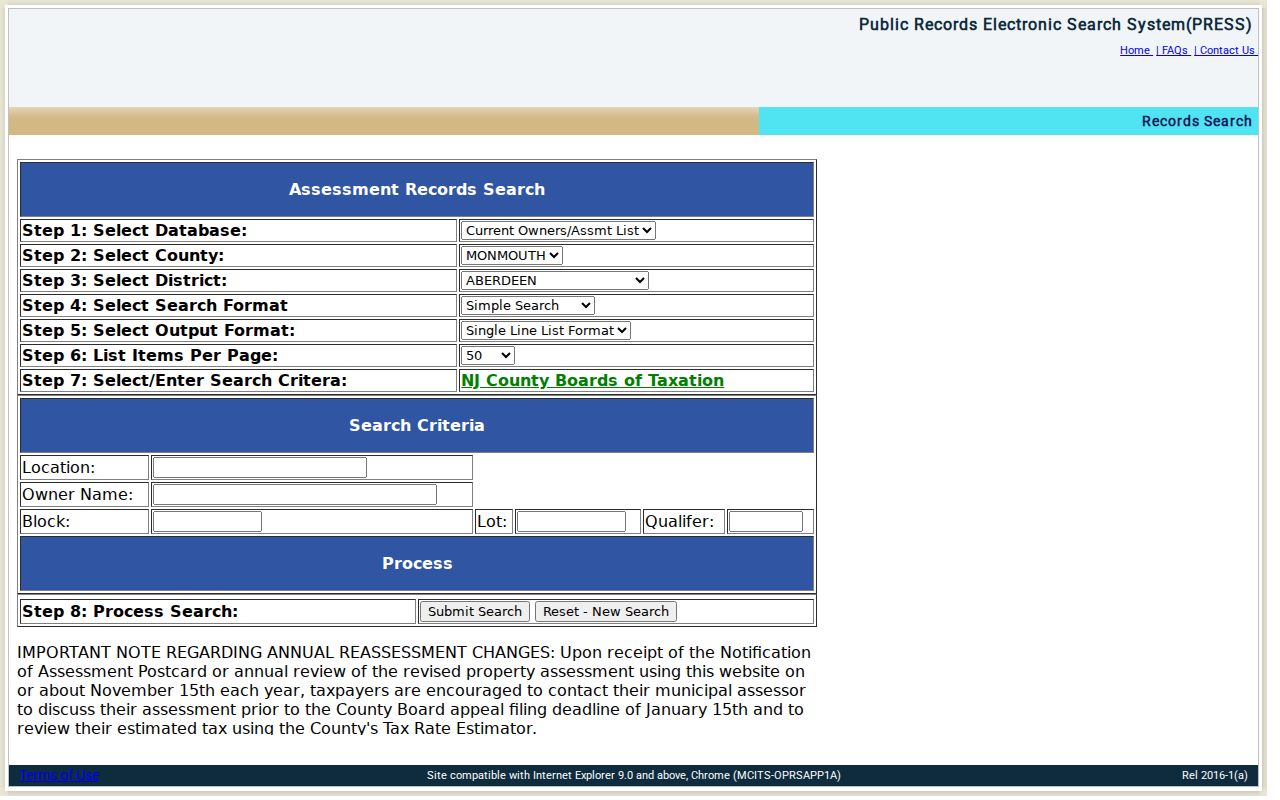
The visible MOD-IV frame is the county layer behind a Hazlet parcel search, not a roster of everyone living at an address.
| MOD-IV search field | Use for a Hazlet search | Format or limit |
|---|---|---|
| Street name | Browse an address or named street | Address mode; select Hazlet and a tax-list year |
| Owner name | Locate an assessed owner | Owner mode; matching behavior is portal-controlled |
| Block and lot | Pin down one parcel | Qualifier is optional for a qualified parcel |
| Year | Choose a tax-list snapshot | Available years are controlled by the portal |
Hazlet Deeds in Monmouth OPRS
For a recorded property trail, the Monmouth County Clerk’s Open Public Records Search System offers free public index searching. Name mode accepts a last or company name, an optional first name, document type, and date range. It also supports the percent sign as a wildcard. Block and lot mode requires the municipality, parcel identifiers, and a date range. The system limits a search window to 90 days, so a long Hazlet deed search must be broken into smaller date windows rather than entered as one broad request.
OPRS gives clear online cutoffs: deeds begin January 1, 1970; mortgages begin January 1, 1976; IRS liens, withdrawals, and releases begin January 1, 2010; and other published records begin October 1, 1996. Results can show parties, instrument or book and page, block and lot, municipality, document type, dates, consideration or loan information, legal description, street address, and a reproduction image. The online image is not certified, and the county says it is not a title search. Formal title work and certified copies belong with the County Clerk counter in Freehold.
Use the Monmouth County OPRS land-records search for the official index and its current cutoff notice.
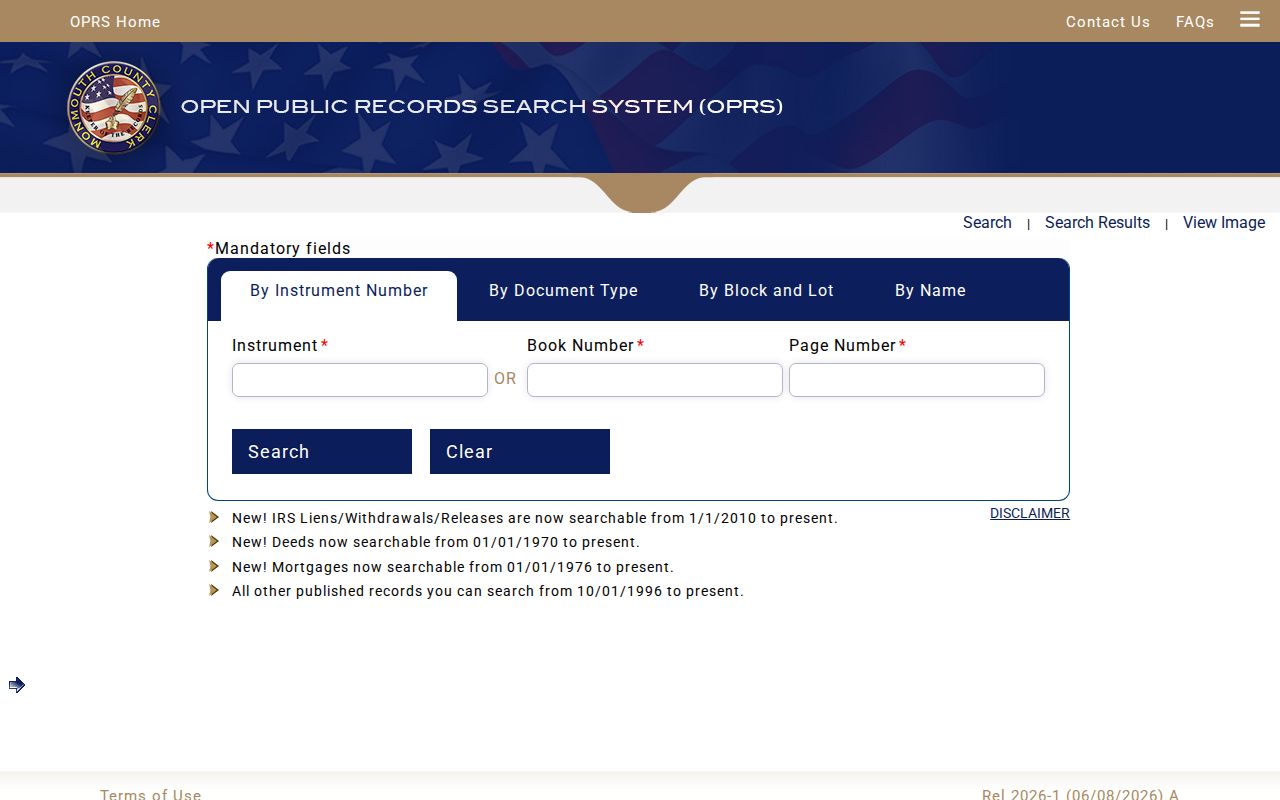
The OPRS screen exposes search modes for instruments, document types, block and lot, and names, which makes it useful after a Hazlet parcel identifier is known.
- Grantor
- The party conveying an interest in a deed, often the seller.
- Grantee
- The party receiving the interest, often the buyer.
- Legal description
- The recorded parcel description, such as block and lot or metes and bounds, used to keep a Hazlet property trail together.
Note: Break a long OPRS search into rolling 90-day periods and keep the date range with each saved result.
Hazlet Voter Lookup Requires Exact Names
New Jersey’s official “Am I Registered?” search can help a Hazlet resident confirm a registration record. The state warns that the name must match the county record. A hyphen instead of a space, a missing middle initial, a nickname, or a married-name change can prevent a match. Check the full legal spelling, date of birth, county, and municipality before assuming the record is absent. The returned voter identifier is used to set up a personal My Voter Record account.
The individual lookup is not an address-browse tool. A broader registered-voter list is requested from the Monmouth Commissioner of Registration under N.J.S.A. 19:31-39, at reproduction cost not exceeding $375. Signatures, Social Security numbers, driver-license information, and covered-person addresses are withheld or redacted. Registration confirms the status recorded by the election system, not who is physically present at a Hazlet address today.
Use the official New Jersey voter registration check only with the details needed to identify the correct record.
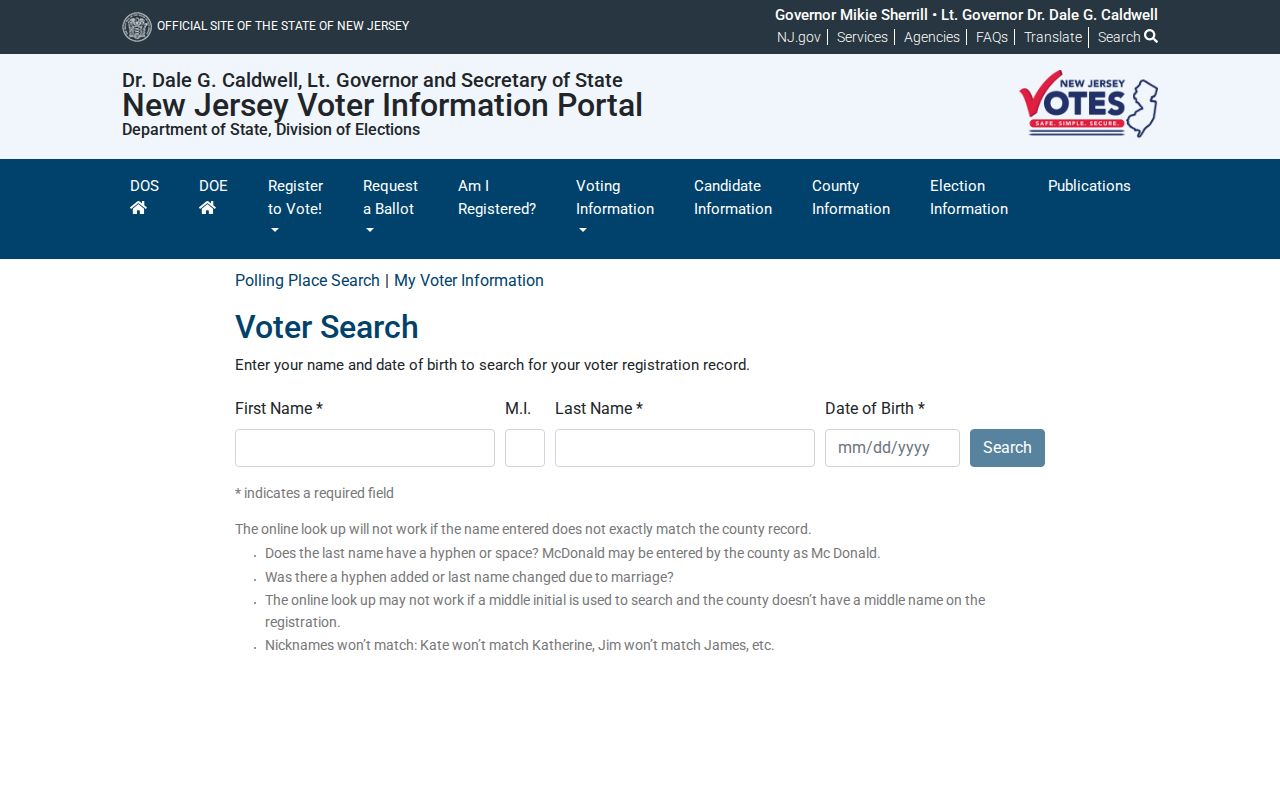
The state lookup screen is a confirmation path for one record, so Hazlet street-wide work needs a lawful county request rather than an assumed public browse feature.
Current Hazlet Resident Directory Sources
A current Hazlet residents directory is assembled from record types with different coverage. Property data is strongest for assessed ownership and parcel location. The voter route is limited to registration questions and protected fields. Deeds preserve parties to transactions, not a live household list. Municipal agendas can name board members, applicants, neighbors, and witnesses, but an agenda is not a resident roll. The township staff directory is a public contact source and does not show who lives in Hazlet.
| Hazlet source | What it can show | Custodian | Access path |
|---|---|---|---|
| MOD-IV tax roll | Assessed owner, property location, parcel and tax details | Hazlet Assessor / Monmouth Tax Board | Free OPRS portal, counter, or phone |
| Land-record index | Parties to deeds, mortgages, and other instruments | Monmouth County Clerk | Free OPRS index; counter for title work or certified copies |
| Voter registration | Registration confirmation for an individual | New Jersey / Monmouth registration office | State lookup or county voter-file request |
| Public meeting records | Names tied to a meeting, application, or public action | Hazlet Township | Agenda search, minutes, or clerk request |
| Community affiliations | Public organization or business association connection | Township and local organizations | Official public pages; no household roster located |
Official records provide an accountable custodian, record date, and access method. Commercial people-finder compilations can mix old address associations, brokered material, and self-reported data, then duplicate people with common names. They may be useful as a prompt for questions, but the Hazlet source record is the place to verify a claim or correct an error.
| Official Hazlet route | Commercial compilation category |
|---|---|
| Shows the custodian, index limits, and record date | May combine material from different times and sources |
| Offers a specific correction or redaction contact | Uses its own privacy or opt-out process |
| Requires the reader to interpret what the record proves | Can join similar names or stale addresses without context |
A street-by-street project belongs on the Hazlet by-street directory, where the parcel and address trail can be handled without turning this broader lookup into a property walkthrough.
Hazlet Permits and Older Files
Hazlet’s SDL permit portal adds a municipal layer to the residents directory trail. A free account is required, and the public instructions say records can be searched by street, address, or block and lot. Its digitized property information begins in 2012. The portal can be useful for dated work, permit, and applicant clues tied to a Hazlet parcel, but it is not a complete historical property file and its public instructions do not expose every logged-in result field.
For pre-2012 permits, use a focused OPRA request to the Municipal Clerk. Name the address and block and lot if available, then ask for a defined record type and time range such as permit applications, inspection reports, approvals, certificates, or code material. Construction, zoning, and code enforcement are distinct Hazlet departments, and no public code-case database was located. A narrow request for an existing record is more practical than asking the township to produce a new report.
Hazlet’s OPRA route uses the New Jersey Open Public Records Act, N.J.S.A. 47:1A-1 et seq. The statutory baseline is a response as soon as possible and no later than seven business days when a record is available, subject to documented exceptions and review needs.
Note: The SDL portal begins in 2012, so older Hazlet permit research should lead with the municipal request path.
Hazlet Court, Estate, and Vital Trails
When a Hazlet residents search concerns a public case, estate, or documented life event, use the correct index rather than treating a name result as a conclusion. The New Jersey Judiciary’s public case-jacket materials show searches by docket number, party name, or judgment where available. A result can supply party name, venue, docket number, caption, and initiation date. It may also lead to events or documents, but not every filed paper is online, and sealed, juvenile, adoption, expunged, and some family material is restricted.
The Monmouth Surrogate’s online probate index covers 1991 forward and is one path for an estate trail. Older research can move to the Russell Index, archives, and court or surrogate procedures. Vital records follow a separate local and state split. Hazlet’s registrar handles local marriages, civil unions, domestic partnerships, and deaths that occurred in the township. New Jersey keeps the most current 100 years at the Office of Vital Statistics and Registry, while older material moves to the State Archives. Certified copies have eligibility and proof rules; a genealogical informational certification is different from a certified record.
The Monmouth County Sheriff’s official inmate-search page currently says the online feature is “Coming Soon” and directs callers to Monmouth County Correctional Institution at 732-431-7860.
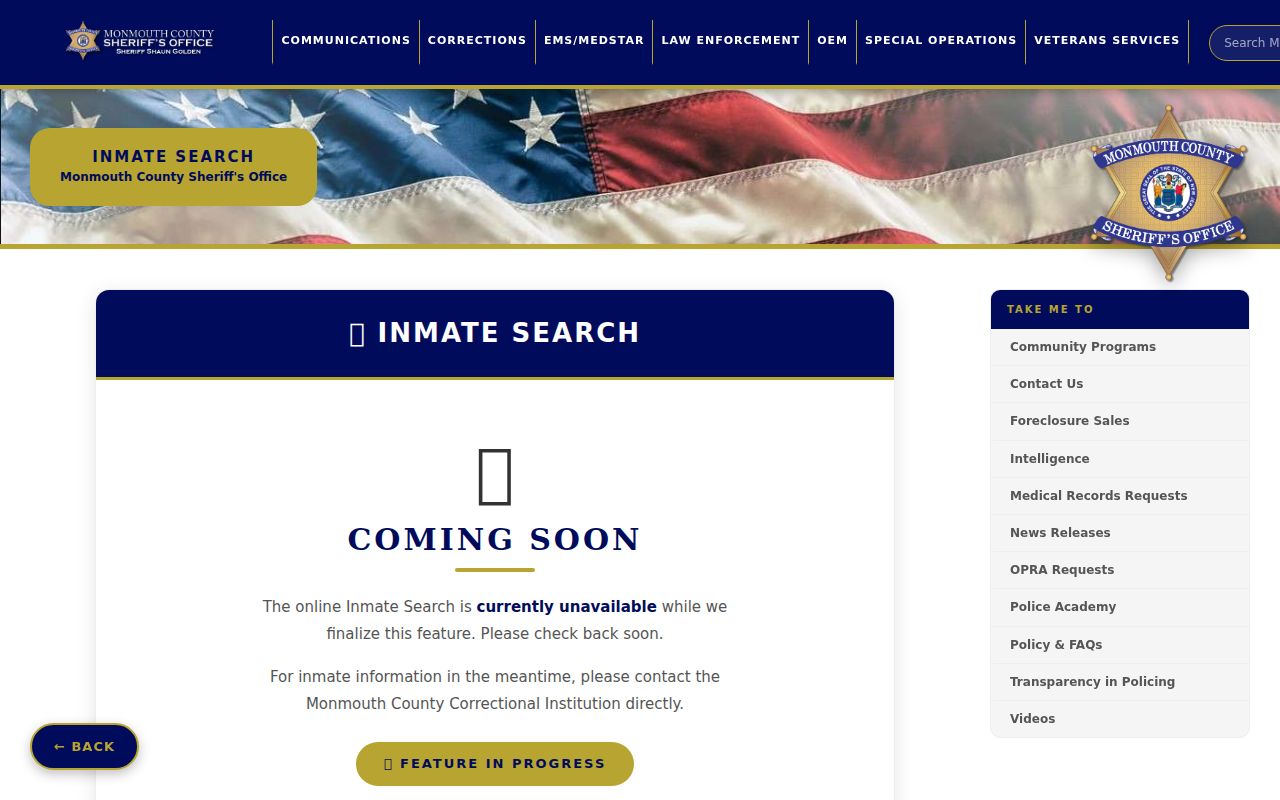
The screenshot documents an unavailable online county feature, so the listed correctional-institution telephone contact is the researched fallback instead of an unofficial roster.
A court entry, an estate index, or a custody status does not establish fault, guilt, residence, or the identity of a person with a similar name. Confirm the docket, venue, dates, parcel, relationship, or another independent identifier.
Hazlet Names Before the Township Name
Hazlet records have a geographic trap that can make a good search look empty. The township formed from Middletown land on February 25, 1848 as Raritan Township. In November 1967, residents voted to rename Raritan Township as Hazlet Township. A historical person, property, municipal action, or address can therefore be indexed under Middletown before 1848, Raritan Township from 1848 to 1967, or Hazlet afterward.
Use the historical municipal name with the approximate date, especially for a deed, census, directory, obituary, or municipal record. The word Raritan also names a broader regional and river context, so pair it with a municipality and date. Postal labels create a second issue: most Hazlet addresses use 07730, while the West Keansburg area is commonly associated with 07734. A postal place is not the same as a Hazlet municipal boundary, and a street-level postal check is needed before relying on a ZIP assignment.
The official township history preserves the Hazlet historical naming and municipal background used for those alternate search terms.
Historical Hazlet Residents at MCHA
For past households, the Monmouth County Historical Association is the strongest verified local repository. Its Research Library and Archives in Freehold lists county and city directories, censuses, cemetery transcriptions, church and Bible records, surname files, wills and estates, and on-site genealogy resources. Its newspaper obituary abstracts cover the Monmouth Inquirer from July 1830 to 1888, the Monmouth Democrat from July 1830 through December 1884, the Freehold Transcript from September 1888 to 1919, and the Red Bank Register from June 1878 through December 1988.
The collection is real, but a key Hazlet directory detail remains unverified: the official page does not publish an exact Hazlet year run, publisher, reverse-directory run, or shelf number. Hazlet Library reports a small historical collection and genealogy/history database access, but it also does not publish a local directory inventory. A request should give the person, street, approximate year, historical municipality, and desired fields, then ask staff to check both alphabetical and address sections if they are available.
- Directory
- A dated publication that may identify people, addresses, and other details, depending on the volume.
- Criss-cross directory
- An address-first directory, if a collection holds one, used to move from a street to a household clue.
- Parcel
- A defined piece of land, commonly tracked in Monmouth records by block, lot, and sometimes qualifier.
Open the MCHA genealogy holdings before arranging an on-site visit. The full historical collection route is described in the Hazlet city directories collection when a dated household trail is the goal.
Note: No official digitized Hazlet directory entry or exact local shelf list was located, so directory fields must be verified from a volume or staff response.
Hazlet Archives and Surviving Minutes
Hazlet’s municipal record history is not a single continuous online shelf. The township’s first minute book began with the March 14, 1848 Raritan Township meeting and ran through May 3, 1895. State Archives holds that early volume. Hazlet’s later municipal material from 1901 through 1998 is at Monmouth County Archives in Manalapan, while Hazlet retains ownership. The transfer includes 18 minute books from August 1920 through December 1970, an ordinance index from 1901 through 1909, and 13 ordinance books from 1909 through 1998.
That history helps interpret a no-result. An old Hazlet matter may predate a portal, use the Raritan Township name, be held by the county rather than the township, or fall within a documented gap. County land records have their own online cutoffs, and SDL begins only in 2012. Search dates and custodian names together rather than assuming that a modern index has every older Hazlet record.
The township’s Research Hazlet resource page directs researchers to the archive, library, newspaper, and local-history routes for this material.
Hazlet Resident Record Privacy Limits
Public access has boundaries. New Jersey’s Address Confidentiality Program gives eligible participants a legal substitute address and mail-forwarding structure, but it cannot erase an address already recorded in a historic deed or public page. Daniel’s Law provides an Office of Information Privacy registration and redaction process for covered people and their immediate households. In Hazlet searches, parcel geometry may remain visible while a hosted tax-list or parcel application redacts an owner name under Daniel’s Law.
Other fields can be withheld as well. Voter signatures, Social Security numbers, driver-license information, and covered-person addresses are not public-file assumptions. Vital records, juvenile matters, adoptions, sealed or expunged cases, investigative records, and certain dates of birth have access rules. New Jersey’s data privacy law does not create a blanket deletion right against a county deed, court file, or archival scan. The right correction path is source-specific: assessor for a parcel card, County Clerk for recorded-document indexing or redaction, election officials for a voter record, registrar or state health office for a vital record, and court clerk for a docket entry.
The New Jersey Office of Information Privacy explains Daniel’s Law protections, and the state Address Confidentiality Program explains its participant protections.
Hazlet’s Aumack Deed Trail
Aumack Family Burying Ground offers a local example of why a Hazlet residents directory should combine sources rather than rely on a modern address alone. The burial ground lies between Virginia and Oregon Avenues in Raritan Ridge and became surrounded by 1950s homes. An 1852 deed reserved the 90-by-100-foot site for the Aumack family as a burial ground forever. A 1933 family survey may identify about two dozen graves, and adjoining-owner deeds helped reconstruct the ground’s access history.
The record trail joins a deed, a cemetery, neighborhood development, and family history. It also reinforces a practical rule for old Hazlet searches: a road can change names while the legal description and dated record preserve the continuity. Township material identifies Lynn Boulevard as a former one-lane dirt road called Aumack Lane. Search both names alongside the older Raritan Township wording, then verify the parcel relationship in the land record.
The township’s Aumack Cemetery restoration history documents the deed and survey context behind this local records trail.
When a Hazlet Search Reaches a Stop
A successful Hazlet residents directory search includes the fallback channel. If OPRS does not reach a deed year, use the County Clerk counter or State Archives microfilm. If a permit predates SDL, direct a focused request to the Municipal Clerk. If a directory volume is not online, contact Hazlet Library, MCHA, Matawan-Aberdeen Library, or Monmouth County Archives with the historical name and approximate year. If an online county feature is unavailable, use the official telephone or counter route stated by that custodian.
For an estate question, the Surrogate and archives are separate paths. For a vital event, the Hazlet registrar, New Jersey Department of Health, and State Archives divide current, certified, and genealogical material. For a court item, identify the docket, venue, and division before asking the clerk about records procedure. A narrow request for an existing record works better than a request for every record about a Hazlet person or address.
Keep a simple search log: the spelling used, Hazlet or Raritan Township name, date range, parcel key, portal or office, and response. It prevents the same dead end from being repeated and makes a later archive or counter search much more useful.