
Hazlet City Directory Collections
For historical Hazlet city directory research, the best verified starting point is the Monmouth County Historical Association Research Library and Archives in Freehold. Its public collection description confirms county and city directories alongside censuses, obituary abstracts, cemetery transcriptions, church and Bible records, surname files, and genealogy databases. Hazlet Library has a smaller historical collection and genealogy or history database access. The town's records page also directs researchers to nearby libraries and archives. These are complementary stops, not interchangeable lists of current residents.
| Historical collection | Confirmed dates or limits | Where to ask | How to use it |
|---|---|---|---|
| Monmouth county and city directories | Exact Hazlet runs and publishers are not confirmed online | MCHA Research Library and Archives | Contact or visit and request a holdings check |
| Hazlet local-history material | 125th Anniversary Journal and anniversary or first-minute materials | Hazlet Library, Town Hall pages, and County Archives | Reference and official digital material |
| Reverse or criss-cross directories | Exact Hazlet years are not published | Ask MCHA, Monmouth County Library, Middletown, or Matawan-Aberdeen reference | Staff-confirmed access only |
| Newspapers and obituary indexes | Matawan Journal 1869-1973; MCHA obituary runs vary by title | MCHA and the local library network | Digital, on-site, or cardholder access by collection |
That gap is important. No inspected official page gives a Hazlet publisher, annual sequence, shelf number, or online scan of a printed entry. Ask for the person, street, approximate year, and whether the desired format is alphabetical, telephone, or address-order. A missing online inventory does not prove that a volume never existed.
Note: Record the title page, edition year, page number, and abbreviation key whenever staff locate a volume.
Hazlet City Directories at Reference Desks
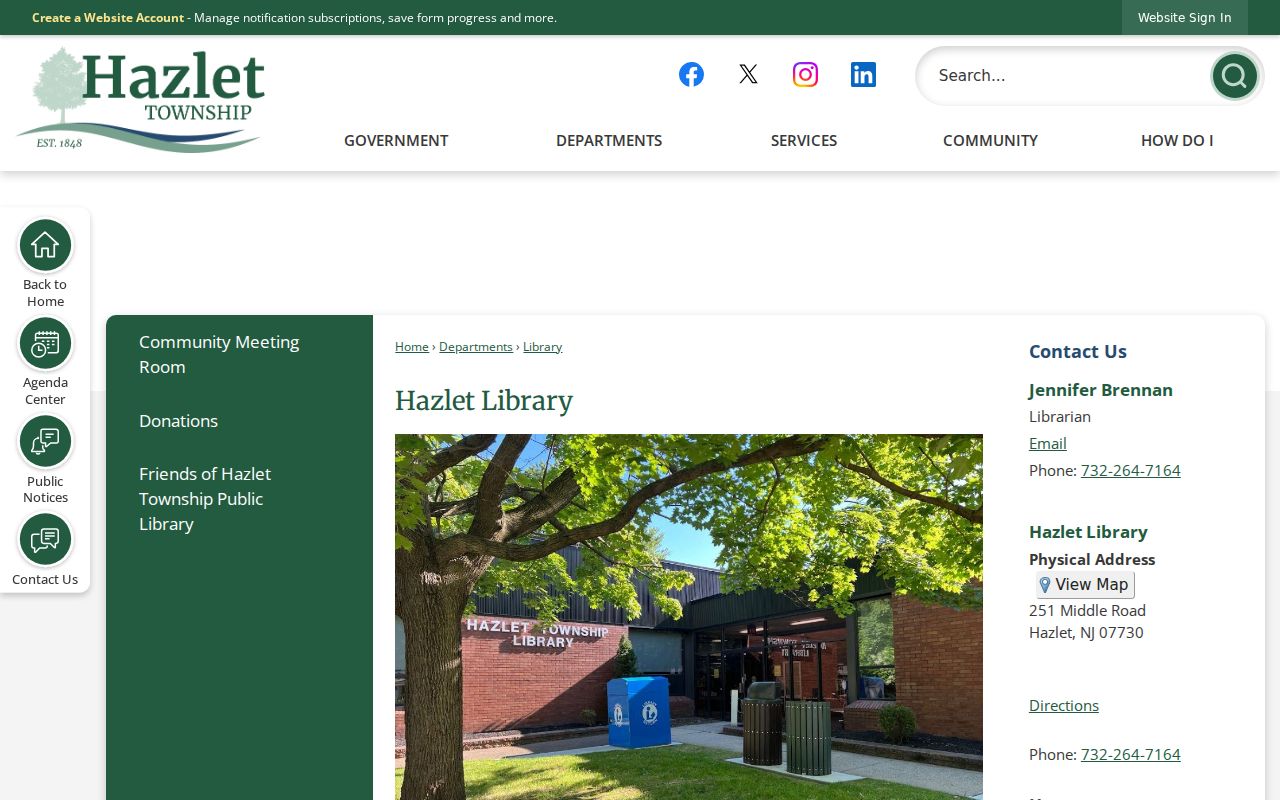
Hazlet Library, at 251 Middle Road, is a practical local starting point for a city directory request. Its official branch page identifies genealogy and history among its database subjects, and its small historical collection can help place a family in the Township's local context. Monday and Wednesday hours are 1 to 9, Tuesday and Thursday hours are 9 to 5, Friday is 1 to 5, and Saturday hours change by season. The library can also point a reader to county-level reference holdings when an exact local volume is not on hand.
The Hazlet Library branch page shows the local library setting used for genealogy and history access.
Use the branch as the first handoff point, then ask whether a county, newspaper, microfilm, or interlibrary route is more likely to answer the date and address in question.
MCHA is the stronger documented historical repository. Its holdings include county and city directories, tax ratables from 1778 to 1820, federal and New Jersey state censuses, cemetery material, church records, and long obituary runs. A concise reference request has a better chance of producing a usable city directory lead than a broad request for every person with a surname.
Hazlet City Directory Years Need Confirmation
Exact directory years and publishers for Hazlet have not been confirmed in the online material reviewed. That means a responsible city directory search should not imply a continuous yearly run, a particular publishing company, or a reverse-directory section. MCHA confirms that county and city directories are among its holdings. Hazlet Library confirms local history and genealogy access. Neither published page identifies the Hazlet sequence in enough detail to claim more.
Give staff a bounded question: a surname with spelling variants, a street name, a date range, and the historical municipality. Ask them to check both an alphabetical section and any address-order volume that is actually held. If a scan or photocopy is supplied, preserve the volume's metadata with the person's entry. That is the way to turn an unverified shelf lead into a cited historical fact.
Reading a Hazlet City Directory Entry
No official digitized Hazlet entry was located, so the fields below are an inspection checklist rather than a claim about any one Hazlet city directory. Once a volume is in hand, look for the head of household, spouse or other household notation, occupation, employer, street address, telephone, owner mark, widow notation, abbreviations, and the editorial key. Some of those elements may be absent. The title page and key tell the reader what a particular editor chose to include.
| Person name | Capture the spelling, initials, and household notation exactly as printed. |
|---|---|
| Street line | Compare the number and road name with a deed or tax-map parcel before treating it as the same property. |
| Occupation or affiliation | Use it as a distinguishing clue, then verify it with a dated source. |
| Marks and abbreviations | Photograph or transcribe the volume's own key before expanding a symbol. |
| Edition details | Keep the publisher, year, page, and format with every transcription. |
- Criss-cross directory
- An address-order directory, if one is confirmed, that can be used to look from a street toward an indexed household.
- Householder index
- An alphabetical finding section for the person named as the household contact, not a complete proof of everyone present.
- Abbreviation key
- The editor's legend, often placed near the front of a volume, that explains shorthand used in that edition.
Do not silently turn an old entry into a current address claim. A city directory is a time-stamped clue that needs a year, source, and follow-up record.
Hazlet City Directories and Raritan Names
Hazlet Township has a name-history trap that affects city directory research. The area was formed from Middletown in 1848 as Raritan Township, and residents voted to rename it Hazlet Township in November 1967. A family, road, or business associated with the same ground may therefore be indexed under Middletown before 1848, Raritan Township from 1848 through 1967, or Hazlet later. Search each form with the date range beside it.
The historical bridge also helps with roads. The Township's Aumack history identifies Lynn Boulevard as formerly Aumack Lane. A deed or newspaper may use the earlier name while a later city directory or map uses the newer one. A legal description, block and lot, or dated map is safer than assuming modern street wording appeared in every earlier source.
- Write the estimated event year beside the name and street.
- Search Hazlet, Raritan Township, and Middletown as the date requires.
- Compare the directory clue with a county deed, tax record, or census.
- Save the historical place name instead of modernizing it without a source.
Newspapers Beside Hazlet City Directories
Historical city directories become much stronger when paired with the documented newspaper sources. MCHA's obituary abstracts cover the Monmouth Inquirer from July 1830 to 1888, the Monmouth Democrat from July 1830 to December 1884, the Freehold Transcript from September 1888 to 1919, and the Red Bank Register from June 1878 to December 1988. Hazlet's research page also points to the Matawan Journal, which runs from 1869 to 1973, as well as Courier and Red Bank Register resources.
Try the name and street after finding the city directory year. An obituary can suggest relatives, a church, or a cemetery. A notice can explain a move or a change in household status. Those clues still need confirmation through a vital, probate, land, or census record, but they keep a city directory search from ending at one unexplained line.
Note: Obituary abstracts identify published notices, not a complete county death index or proof of family relationships.
Tracing Families With Hazlet City Directories
For family history, use a Hazlet city directory as one dated stop in a longer sequence. Begin with an address from a deed or tax roll, then ask whether a confirmed alphabetical or address-order directory covers the target period. Track initials, spouse notation, occupation, and the way a street name is printed. Pair the closest directory year with the available federal census, which is generally public after 72 years, or with New Jersey state censuses from 1855 to 1915. Monmouth's 1875 census is available through County Archives.
- Locate the earliest confirmed directory appearance for the surname, address, or street.
- Compare nearby confirmed editions and record only changes actually printed.
- Pair the city directory year with a census, tax roll, or deed for household and parcel context.
- Use MCHA obituary, church, cemetery, or surname material to test a departure or succession.
- Search Raritan Township or Middletown terminology when the Hazlet name does not fit the year.
A person dropping out of a directory can reflect a move, death, a changed editorial policy, or a missing volume. It is not enough by itself to establish why the household changed.
Hazlet Directory Clues in the Aumack Story
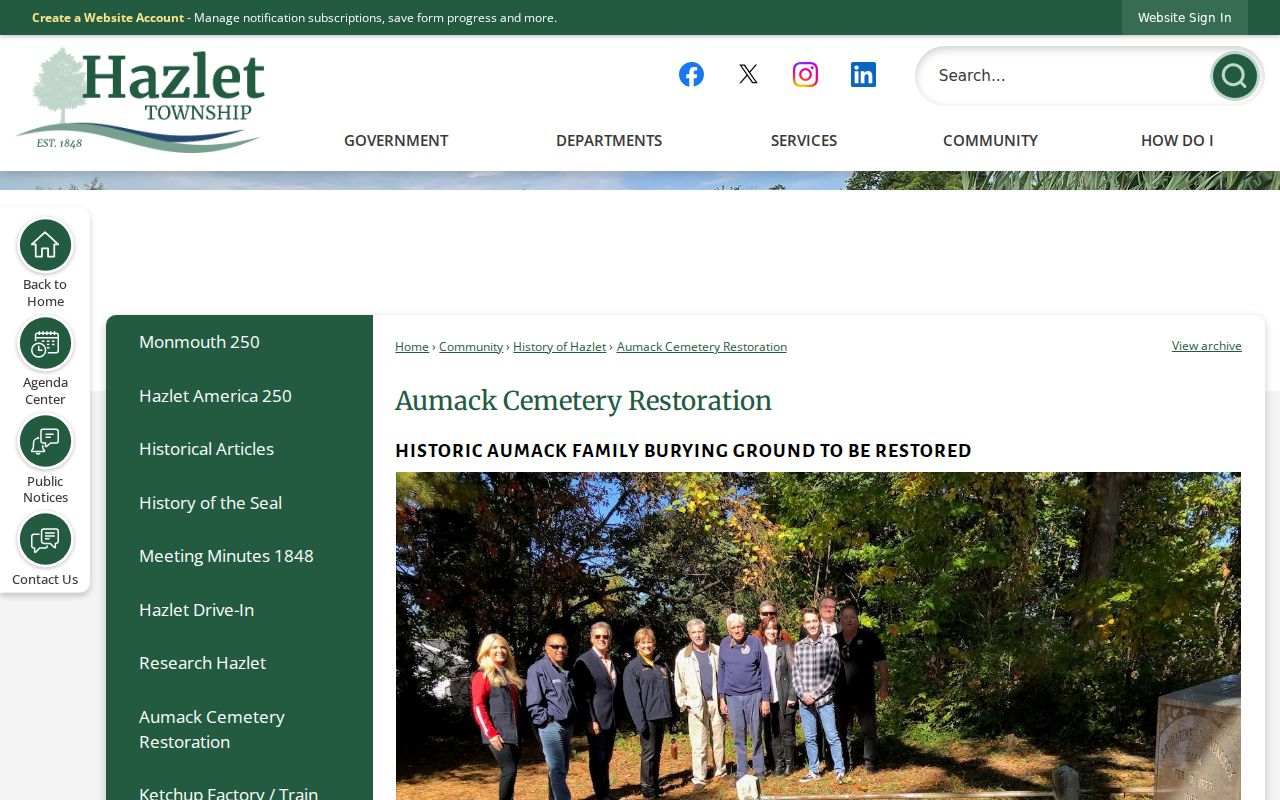
The Aumack Family Burying Ground offers a local example of why one record type should not carry the whole story. The Township says an 1852 deed reserved the small burial ground for the Aumack family forever. A 1933 family survey may identify about two dozen graves, while later adjoining deeds helped reconstruct access after Raritan Ridge development surrounded the site. Names, roads, and land descriptions work together here.
The Township's Aumack Cemetery Restoration page documents this deed-and-cemetery history.
A city directory, if staff locate a relevant volume, could add a dated address or occupation clue to this type of local history. It cannot replace the deed, survey, or cemetery evidence that establishes the underlying land story.
State Archives Beyond Hazlet City Directories
When the city directory shelf stops, the New Jersey State Archives genealogical collections provide a different layer of evidence. The Archives holds county deeds on microfilm to 1900, mortgages to 1850, county surrogate material, vital indexes, censuses, court material, and military records. Its reading room research is free, though copies can have charges. The older trail is especially useful where an online county land index begins later than the family question.
The State Archives collection page identifies the kinds of genealogical records available for Monmouth and New Jersey research.
Use the State Archives as the older-record route, not as an assumed city directory repository for an unconfirmed Hazlet edition.
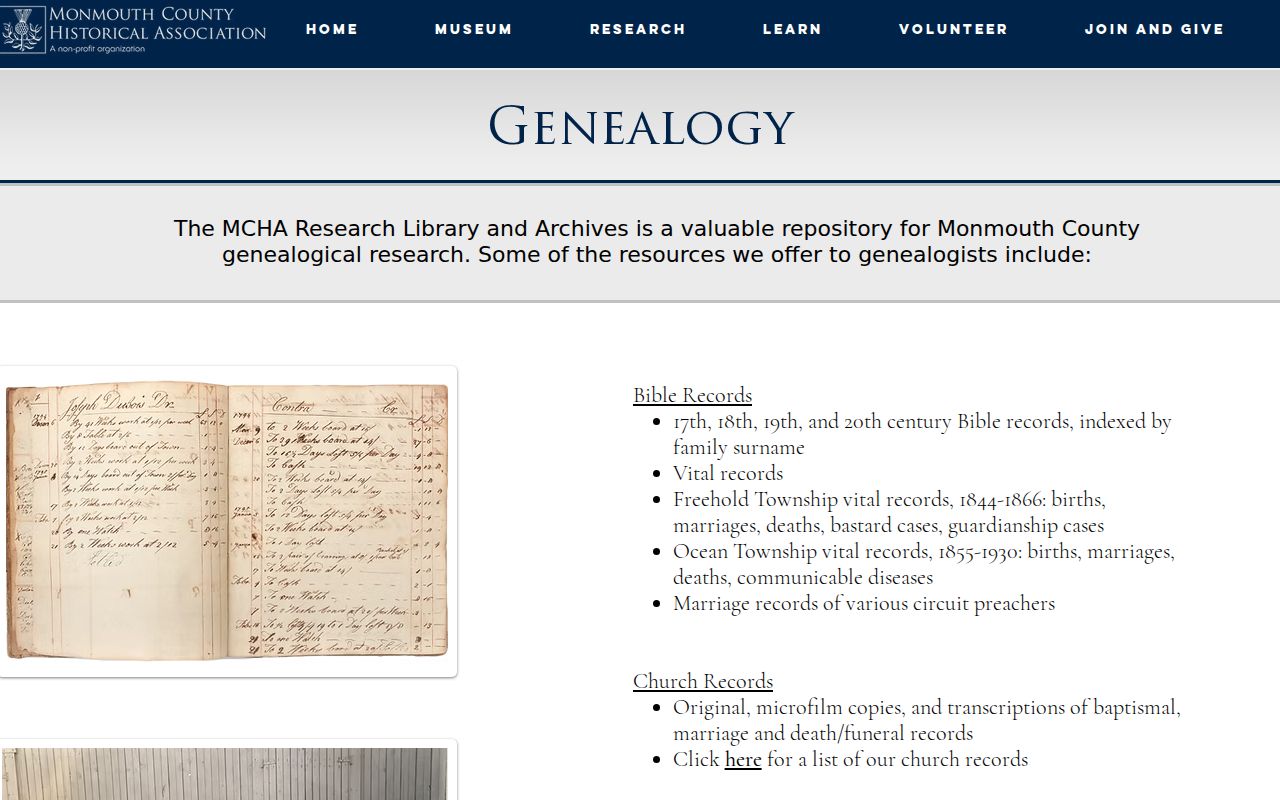
The MCHA collection is also the best verified source for county and city directories, obituary abstracts, cemetery transcriptions, and census materials.
The MCHA genealogy holdings page describes those historical collections.
Confirm the exact title and dates with MCHA before citing a city directory volume for Hazlet Township.